
|
|
Is globalization challenging your people?
"It is now clear that global change will be a way of life in the 1990s and beyond - At the center of these changes, as always, will be people. Employees, managers, and leaders of organizations struggling to adapt to the new world rushing toward them - and away from them."
---Stephen Rhinesmith in A Manager’s Guide to Globalization<
Individual people, in countless ways, determine the success or failure of cross-border organizations. How well or how poorly they learn and perform their cross-border roles and fulfill their cross-cultural responsibilities is critically important in all types of international organizational arrangements and at all stages of globalization. The intercultural knowledge and skills of these employees are valuable assets. The quality of their worldwide relationships shapes their organization or company’s’ global reputation and strongly influences the performance of its international mission.
One key indicator of success/failure is the ability of expatriate employees and families to complete their assignments overseas. The actual worldwide average failure rate of US international assignees is difficult to determine. Various surveys during the 1990s have contained widely differing results. The lowest figure for failed assignments was reported by Personnel Journal in 1993 at around five percent. The February 1995, issue of International Business noted that up to 40 percent of US managers did not complete their assignments. Other surveys have indicated attrition rates in the 20-30 percent range. What is clear is that even a single failed overseas assignment is exceedingly expensive and well worth preventing by proper selection, training, and support.
Senior management recognition of the importance of all cross-border roles is a prerequisite for gaining support for the use of intercultural services to train and develop employees to handle their transnational roles and responsibilities. A practical way you can increase senior managers’ awareness is to inventory the type and number of cross-border roles that exist in your organization or company. This exercise often results in the discovery that considerably more employees than originally thought are engaged in important cross-border activities and relationships. The surprise is because the internationalization of their jobs usually evolves gradually over time without formal planning or redefinition of their jobs.
The inventory will also help you verify the contributions of these roles to your international mission and determine which employees need intercultural skills. This information is essential to you as a potential user of intercultural services. In order to select the most appropriate services and utilize them effectively, you need to first identify the cross-cultural requirements of all the cross-border roles.
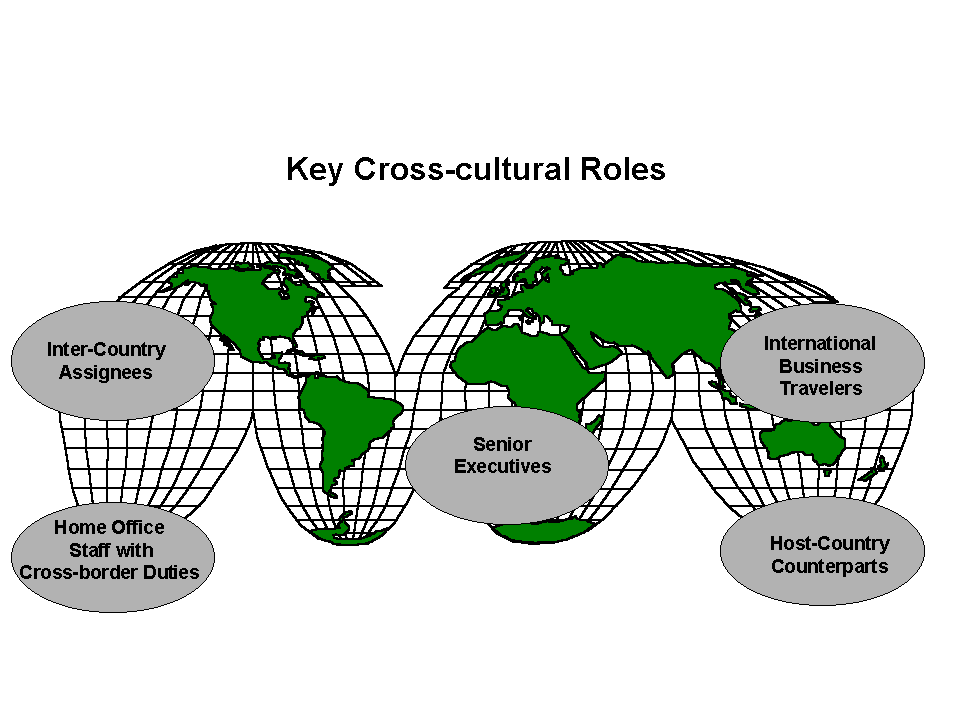
Most employees who must be able to perform multiculturally are found in five groups: senior home office executives, inter-country assignees, international business travellers, home office staff, and host-country employees and counterparts. These groups do not correspond either to job classifications or organizational levels. The employees may or may not live abroad. They may not even travel internationally. Their interaction with people from other cultures may be face-to-face or at long distance. The critical common denominator is that their jobs require maintaining international communications and relationships important to the company’s business. These are the people most likely to benefit from intercultural services.
4 of 6 > Previous page > Next page
This article copyright © Gary M. Wederspahn. All rights reserved.
HRM Guide makes minimal use of cookies, including some placed to facilitate features such as Google Search. By continuing to use the site you are agreeing to the use of cookies. Learn more here
|
|
|
|
|
|
|
|
|
| Copyright © 1997-2026 Alan Price and HRM Guide contributors. All rights reserved. |